
The Best First Japanese Kitchen Knife
Everything below is the reasoning behind that answer, including what changes when you spend more or less.

1Gyuto vs santoku: which is better for home cooking?
Neither wins in the abstract; your cutting board settles it. Our santoku guide states the rule we use in the shop: "choose a gyuto if you want one do-everything knife with more reach, or a santoku if you prefer a compact, easy-to-control blade." Take the gyuto if you have the bench space. At about 210 mm it is, as our gyuto guide puts it, "a multi-purpose knife designed to perform well at many differing kitchen tasks, rather than excelling at any one in particular", and the pointed tip and lifted curve cover slicing as well as chopping. Take the santoku if the kitchen is tight. At 165 to 180 mm, our santoku guide says it "rewards a straight up-and-down push cut, feels nimble in smaller hands or tight kitchens". Measure the board, then pick the shape.
A gyuto is the Japanese take on the western chef's knife. It has a longer, flatter edge with a curve that lifts to the tip, so it push-cuts, rocks and slices without complaint. A santoku is shorter and flatter with a blunter, dropped tip. It excels at straight-down chopping, and gives up some tip work and long-slice capability in exchange for feeling more manageable in a small space.
Between them they cover the whole weeknight. Every other shape you will see in a "top ten" list is a specialist that exists because a professional kitchen needed one particular cut done ten thousand times. A petty is a support knife, not a main. Single-bevel knives like the yanagiba, deba and usuba are sharpened on one face only and want a completely different sharpening technique. They are built for tasks most home cooks do a few times a year. Buying one first is how people end up with a beautiful knife in a drawer and a supermarket knife on the board.
If you buy one Japanese knife, buy the one you will pick up every day.
When not to choose this. If you regularly break down large cuts or cook in large volumes, you may want more reach than either offers. Our gyuto guide sets the exception plainly: "Step up to a 240mm only if you regularly break down large cuts", and a 240 mm blade also wants a board long enough to use it. If your only objection to the santoku is the blunt tip, read the next section rather than compromising on length.
2Bunka vs santoku: which is better for home cooking?
For most home cooks, choose the santoku; choose the bunka only when you want a point on the end. Their size bands overlap: our bunka guide describes the shape as "a blend of the Santoku and K-tip Gyuto knives, with a blade length typically around 165mm to 180mm", so this is a tip decision rather than a size decision. The santoku keeps a rounded tip out of your way, and, as our santoku guide puts it, "The whole point is a flatter profile, so it suits push-cutting and quick chopping more than a long rocking motion." The bunka keeps that flat edge and, as our bunka guide puts it, adds "a straighter edge and a pointed tip". That is the trade.
What the point buys you is precision at the tip. Our bunka guide describes that payoff directly: "The angled tip, also known as a reverse tanto, provides additional precision for intricate tasks such as julienning". If those cuts are a regular part of your prep, take the bunka. If they are not, the santoku is the plainer choice. Both are covered further on the santoku and bunka guides.
When not to choose this. If this will be your only knife and you regularly break down large cuts, skip both and take a 240 mm gyuto instead. At 165 to 180 mm, neither compact shape gives you the same reach.
3Which shape should my first Japanese knife be?
An all-rounder: a gyuto of about 210 mm, or a santoku or bunka of 165 to 180 mm if your board is small. Our gyuto guide is direct about the length: "In a home kitchen I'd pick a 210mm gyuto. It's the sweet spot: long enough for a full slicing stroke, short enough to stay nimble on a normal cutting board". Choose the gyuto when you need reach and slicing room; choose the shorter santoku or bunka when board space matters more. That keeps the first purchase focused on the work you do every week. Let the kitchen choose the shape, and settle steel in the steel section below.
Length is not seniority. Our gyuto guide puts it as bluntly as we do in the shop: "Longer is not more professional, it's just for bigger food." The three shapes each have their own guide: gyuto, santoku, and bunka.
When not to choose this. If you already own a chef's knife you are happy with and it is sharp, a second all-purpose shape is the wrong thing to buy first. Put the budget into sharpening instead; our whetstone guide for beginners is the place to start.
4Size: your cutting board decides this, not your hands
The most common sizing mistake is picking by confidence when bench space should be doing the deciding. A 210 mm gyuto needs a board with room for the blade to travel and for your knuckles to clear the edge of it. If your board is a small chopping mat, a 210 will feel unwieldy, you will cut cautiously, and you will conclude the knife is wrong when the board was.
A rough guide, from what people report back to us:
- Generous board, standard bench, you cook most nights: 210 mm gyuto. This is the default for a reason.
- Small board, apartment kitchen, or you are stepping up from a short European knife: 165 to 180 mm santoku. Shorter, flatter, easier to control in a confined space.
- You cook large volumes and already own a big board: a 240 mm gyuto is a legitimate first knife, but it is a smaller group than people think.
Nobody has ever told me they regretted the 210. A reasonable number of people have told me their 240 lives at the back of the drawer.
One more thing that surprises first-time buyers. Many Japanese knives come with a wa handle, the light octagonal or D-shaped wooden handle that sits on the tang rather than wrapping around it. It feels unfamiliar for about a week and then it feels obvious, because it moves the balance forward into the blade. Western-style handles with a bolster exist across most ranges too, and if you strongly prefer the familiar shape, that preference is worth respecting.
5Steel: what it actually changes about your Tuesday
Beginner guides go vague at this point, so this is the practical version.
Stainless-core steels like VG10, Ginsan (also written Gin-3 or Silver 3), SG2 and the AUS family resist rust well enough that ordinary kitchen carelessness does not cost you anything. Rinse, wipe dry, put it away. VG10 is typically run around 60 to 61 HRC, holds a very good edge and resists staining well. Ginsan is a Hitachi kitchen-knife stainless in a similar hardness band, and it takes a fine edge on a stone with less fuss than most stainless steels.
Carbon steels like White (Shirogami), Blue (Aogami) and Aogami Super sharpen beautifully and take an edge that enthusiasts chase. They also react. Leave one wet on the board for twenty minutes and you get a patina at best and orange spots at worst. Cut a lemon and you will watch the blade change colour while you work.
One part of this catches people out: a stainless-clad carbon knife is not a low-maintenance knife. Cladding covers the flats. The cutting edge is exposed core steel, because it has to be. So the part that touches the acidic, wet food is the reactive part. Clad carbon knives are wonderful. They are just not the forgiving option, and any guide implying otherwise is selling you something.
For a first Japanese knife, take the stainless core. If carbon steel turns out to be your thing, it will still be there in a year, and you will be a much better judge of it.
Hardness is the other half of the trade. Japanese knives are generally harder than European ones, which is why they get sharper and stay sharp longer. Hard steel is also less forgiving of abuse. It does not want bones, frozen food, glass or stone boards, or the twisting motion people use to lever a pumpkin open. Use it only to cut and the hardness is pure upside.
6What to spend, and why both extremes disappoint
The useful range for a first Japanese knife is roughly $150 to $300 AUD. That is not a marketing band. It is where the manufacturing changes.
Under about $100, you are usually buying a knife that is Japanese in styling more than in construction: softer steel, a thicker grind behind the edge, and a factory edge that will not last. Cheap is not the issue in itself. The issue is that a knife like this will not show you what the fuss is about, so you conclude that Japanese knives are overrated when what you actually bought was a knife-shaped object.
Between $150 and $300, you get the things that make the difference: steel that is properly heat-treated, and a blade that is thin behind the edge. That thinness is what people are describing when they say a Japanese knife "falls through" an onion. It is a grinding and finishing cost, and it is the single largest contributor to how a knife feels in use.
Above $500, you are mostly paying for craft, rarity, finish work and the name of the person who made it. These are real things and I sell plenty of them, but none of them make the knife cut better for a beginner. Worse, an expensive first knife carries a fear tax. People baby a $600 knife, use it less, and learn less. Buy the good $200 knife, use it hard for a year, learn what you actually want, and let the $600 knife be an informed decision.
Spend the difference on a cutting board and a sharpening stone. Both will do more for your cooking than the next $200 of knife.
7Two I would hand a first-time buyer
These are the two I point people at in the shop. Stock moves constantly, so check the current product page before you commit.
If you have already settled on a gyuto and set a firm ceiling, our guide to the best gyuto under $300 goes deeper on that one question.
| The default | If your kitchen is small | |
|---|---|---|
| Knife | Hatsukokoro Hayabusa VG10 Tsuchime Sanmai Gyuto | Hatsukokoro Ginrei Ginsan Santoku, Nashiji Ebony |
| Shape | Gyuto | Santoku |
| Length | 210 mm | 175 mm |
| Core steel | VG10 stainless, 60 to 61 HRC | Ginsan stainless, a similar hardness band to VG10 |
| Handle | Wa handle | Octagonal ebony, single piece |
| Price | Currently out of stock | ₩156,000 |
| Who it is for | Most home cooks, a generous board, you cook most nights | Small board, apartment kitchen, or stepping up from a short European knife |
The default: Hatsukokoro Hayabusa VG10 Tsuchime Sanmai Gyuto 210 mm, about $190

Hatsukokoro Hayabusa VG10 Tsuchime Sanmai Gyuto 210mm. Live price and stock on the product page.
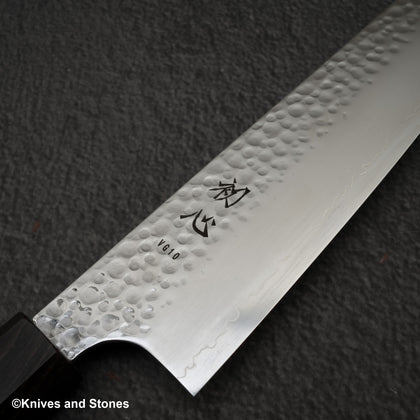
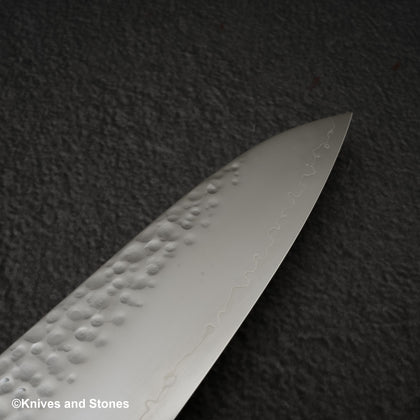
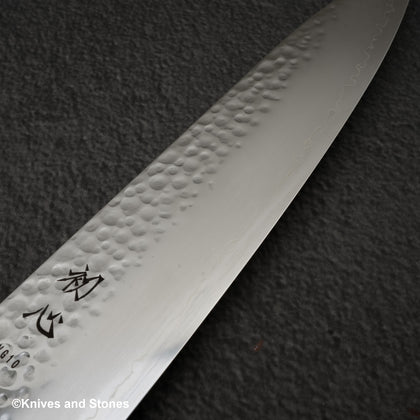
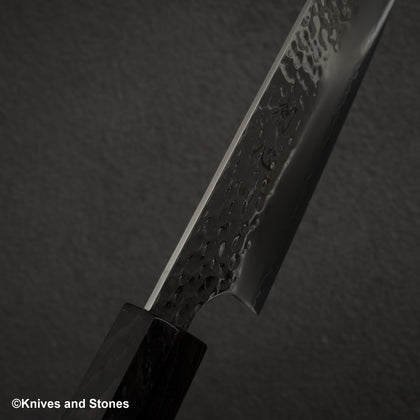
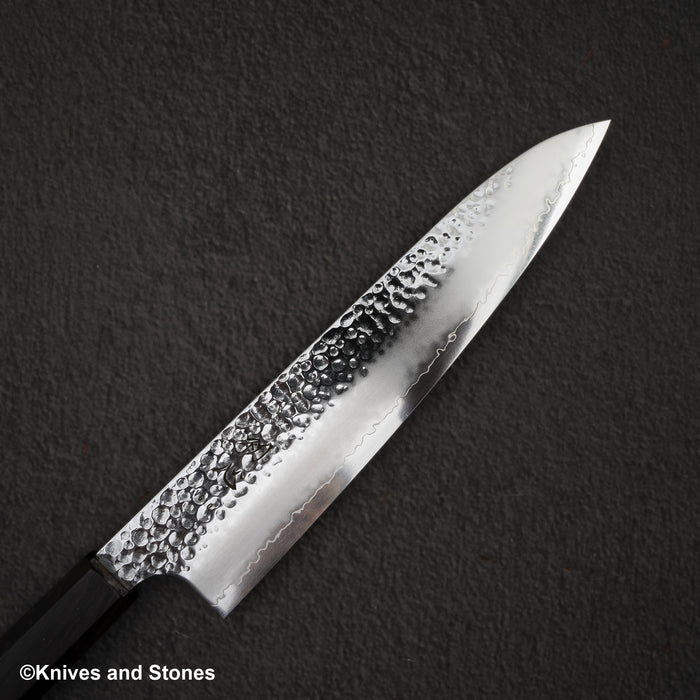
This is the shape and size that answers the question, in a steel that will not punish you for a distracted evening. VG10 is a well-understood stainless core, run in the 60 to 61 HRC range, with the edge retention and corrosion resistance that make it the sensible default for a knife that has to live in a real kitchen. The sanmai construction means that hard core is laminated between softer stainless layers, which is both a toughness and a cosmetic decision. The tsuchime (hammered) finish on the flats reduces how much food clings to the blade as you cut.
Why this one: it lands the whole recommendation in one object. A 210 mm gyuto, stainless core, thin enough behind the edge to feel like a Japanese knife, without the heft of a European one, at a price where you are not frightened of it. It is comfortably under what people expect to pay, and I would rather you spent the remainder on a stone.
The trade-off: it is a wa handle, so if you are certain you want a western handle with a bolster, this is not your knife. And VG10 is a workhorse steel; excitement is not what it is for. It will not give you the sharpening experience that carbon-steel enthusiasts talk about, which, at this stage, works in your favour.
If your kitchen is small: Hatsukokoro Ginrei Ginsan Santoku 175 mm Nashiji Ebony, about $180

Hatsukokoro Ginrei Ginsan Santoku 175mm Nashiji Ebony. Live price and stock on the product page.
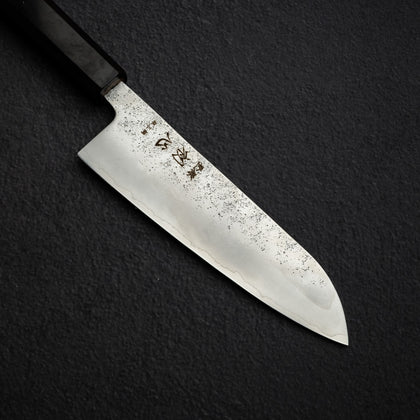
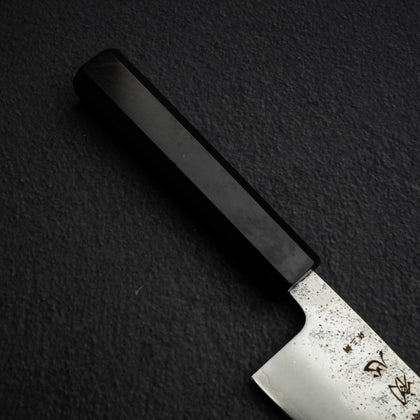
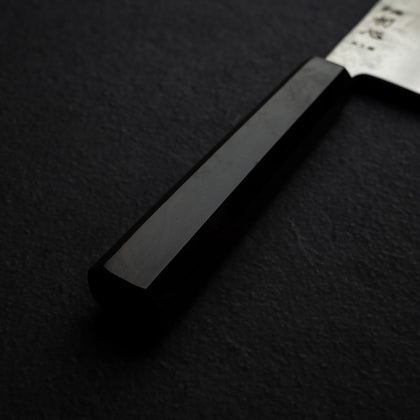
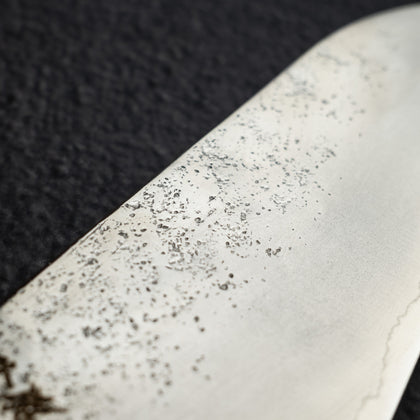
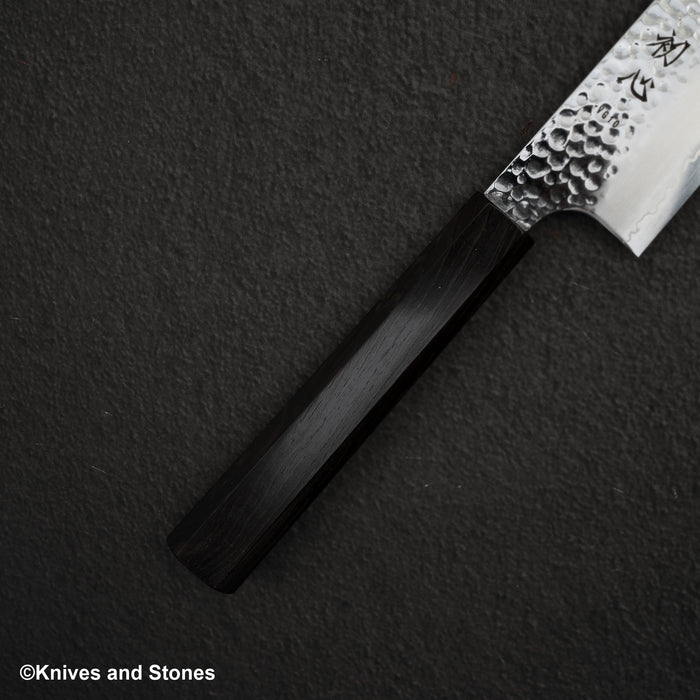
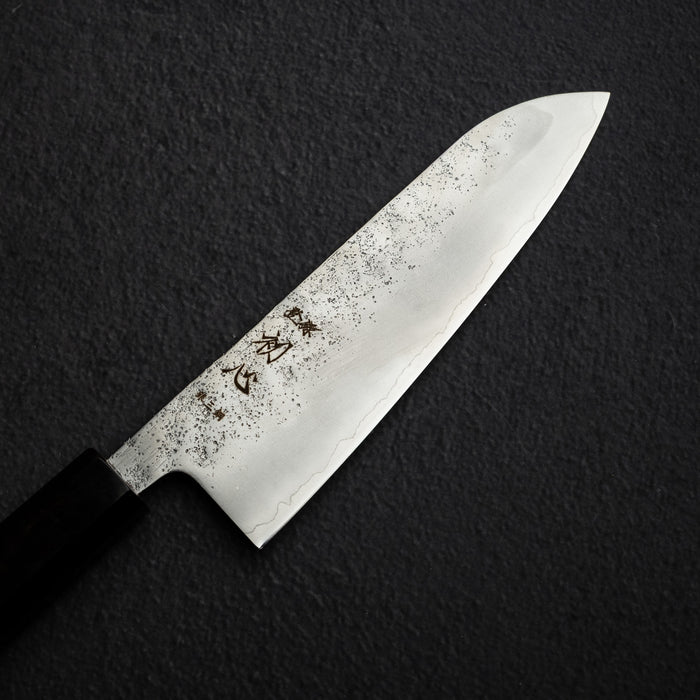
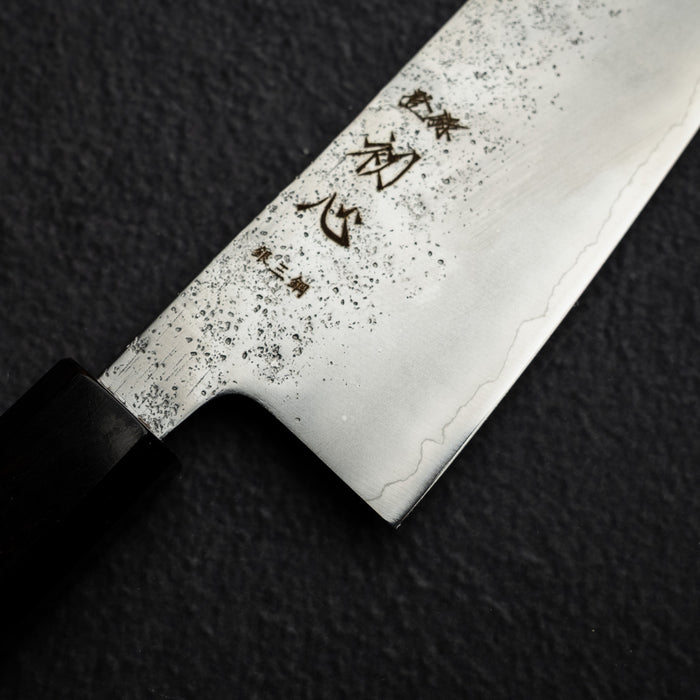
Choose this instead if your board is small, your bench is crowded, or you are moving across from a short European knife and want the shortest possible adjustment. It is a santoku in the size band that suits a home kitchen, in Ginsan: a Hitachi stainless designed for kitchen knives, run in a similar hardness band to VG10, and unusually pleasant on a stone for a stainless steel. The nashiji (梨地, "pear skin") finish is the slightly textured surface on the flats, and the handle is a single piece of octagonal ebony.
Why this one: it is the small-kitchen answer without being a downgrade. Ginsan gives you a fine edge and easier sharpening than most stainless, so the knife rewards you as you improve rather than capping you. At roughly the same money as the gyuto, the only decision left is shape.
The trade-off: you lose the tip work and the long slicing that a gyuto does well. That rules out filleting a side of salmon and clean single-stroke cuts through a large roast. A santoku is also thinner and harder than the stainless knife you are replacing, so it wants a wooden or soft plastic board and no bones. If you are torn between the two, the gyuto is the more versatile knife and the santoku is the more comfortable one.
8What to skip, and why
Knife sets and blocks. You pay for four knives you will never use to get one you will. Buy a single good knife, then add only what you find yourself missing.
A $50 "Japanese-style" knife as a test run. This is the most expensive way to save money, because it teaches you the wrong lesson and you buy twice.
A $600 knife as your first. Fear makes you cut worse. Come back to it when you know what you like.
A petty or paring knife as your first Japanese knife. These are support tools. They are excellent at what they do and they are not the knife you reach for.
Single-bevel knives: yanagiba, deba, usuba. Different sharpening discipline, different technique, built for tasks a home cook does occasionally. Beautiful, and wrong first.
Buying the damascus pattern. The layered pattern is in the soft cladding, not the cutting edge. It is decoration, and it is fine to want decoration, but it does not cut better. Two knives with the same core steel and the same grind will perform the same whether one is patterned or not.
Glass, stone, ceramic or steel cutting boards, and the dishwasher. These are how thin, hard Japanese edges die. End-grain wood or soft plastic, hand wash, dry immediately.
The ribbed steel rod that came with your old knife block. It is designed for softer western steel. On a hard Japanese edge it does more harm than good.
Questions people ask
Is a santoku or a gyuto better for a beginner?
Neither is better in the abstract. Choose a 210 mm gyuto for more reach and tip work, or a 165 to 180 mm santoku for easier control in a small kitchen. See the full comparison above.
Can Japanese knives go in the dishwasher?
No. The heat and detergent are bad for the steel, the knocking around is worse for the edge, and a wooden handle will dry out and eventually loosen. A Japanese knife takes about eight seconds to look after: rinse, wipe dry with a cloth, put it away. If the blade has a carbon core, do that immediately rather than after the meal.
How much should I spend on my first Japanese kitchen knife?
Roughly $150 to $300 AUD covers it comfortably. Below about $100 the steel and the grind are usually not good enough to show you why Japanese knives are worth owning. Above $500 you are paying for craft, rarity and finish rather than for a better everyday cutter. You do not need to spend more here. A well-made knife at $200 will serve a home kitchen better than a knife at three times that price which you are too nervous to use properly.
Do I need a whetstone to own a Japanese knife?
Eventually, yes, and it is worth learning. Every knife dulls, and pull-through sharpeners are built for thicker, softer western blades; running a hard, thin Japanese edge through one tears out steel it cannot replace. A single combination stone in the 1000/3000 grit range, plus twenty minutes of practice, will keep a knife sharper than most restaurant kitchens manage. In the meantime, a good knife holds a usable edge for months of home cooking, and we sharpen knives for customers if you would rather not learn straight away.
