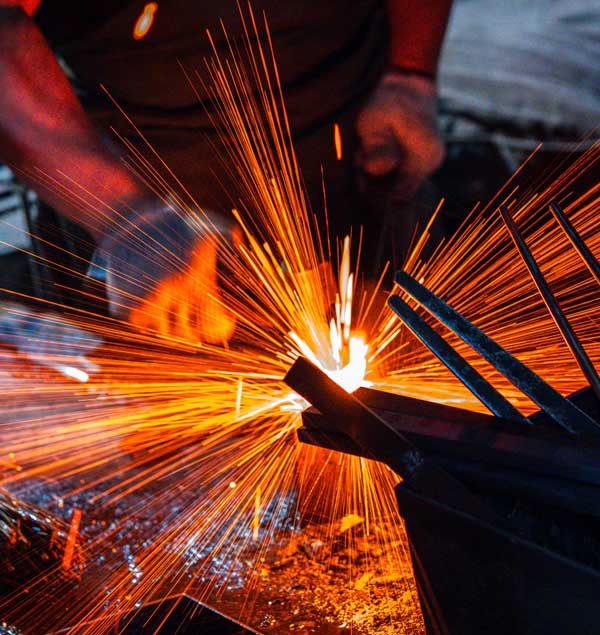
Carbon Steel
Carbon Steel
Carbon steel is reactive — it will rust quickly if not properly cared for. Always wash immediately after use, dry thoroughly, and apply a thin coat of food-safe oil (camellia, mineral) before storage. Over time it develops a patina that offers some natural protection and, for many users, becomes part of the knife's character. Rewarding to use, but not recommended if you want a "wash and forget" knife. 타케후 특수강, 일본
Carbon steel is reactive — it will rust quickly if not properly cared for. Always wash immediately after use, dry thoroughly, and apply a thin coat of food-safe oil (camellia, mineral) before storage. Over time it develops a patina that offers some natural protection and, for many users, becomes part of the knife's character. Rewarding to use, but not recommended if you want a "wash and forget" knife. 타케후 특수강, 일본
V-Toku 1 V금1호
Hardness
Rockwell C Hardness(HRC) measures how resistant a steel is to permanent deformation. For kitchen knives:
55–58 HRC — Soft. Easy to sharpen and forgiving of rough use, but dulls faster. Typical of most German knives.
59–61 HRC — Balanced. Good edge retention with manageable sharpening. Common in mid-range Japanese knives.
62–64 HRC — Hard. Excellent edge retention, holds a very fine edge. Requires more care and a fine stone to sharpen.
65+ HRC — Very hard. Exceptional edge longevity but more brittle — more prone to chipping if used roughly.
Higher is not always better — it depends on how you use and maintain your knife.
55–58 HRC — Soft. Easy to sharpen and forgiving of rough use, but dulls faster. Typical of most German knives.
59–61 HRC — Balanced. Good edge retention with manageable sharpening. Common in mid-range Japanese knives.
62–64 HRC — Hard. Excellent edge retention, holds a very fine edge. Requires more care and a fine stone to sharpen.
65+ HRC — Very hard. Exceptional edge longevity but more brittle — more prone to chipping if used roughly.
Higher is not always better — it depends on how you use and maintain your knife.
62–64
HRC
555759616365+
V-Toku 1(V特1号, V-Special 1)은 타케후 특수강이 클래식한 히타치 청1강을 재해석한 강재입니다. 합금 탄소강으로서 화학 성분이 청1강과 매우 유사하며, 바나듐과 약 1% 더 많은 텅스텐이 추가되었습니다. 타케후가 주장하는 높은 순도와 결합되어, V-Toku 1은 청2강보다 약간 향상된 내마모성을 가집니다.
V-Toku 1은 우수한 경화능을 갖추고 있어 HRC64까지 경도를 높일 수 있으며, 많은 제작자들이 이러한 경도를 활용해 음식을 매우 잘 썰어내는 극도로 얇은 칼날을 만듭니다. 또한 타케후는 구리나 청동 층이 포함된 적층 빌릿도 생산하므로, 유럽 및 미국 제작자들의 칼에서도 V-Toku를 찾아볼 수 있으며, 이를 통해 많은 셰프들이 탄소강 칼의 뛰어난 절단 경험을 누릴 수 있습니다.
V-Toku 1은 우수한 경화능을 갖추고 있어 HRC64까지 경도를 높일 수 있으며, 많은 제작자들이 이러한 경도를 활용해 음식을 매우 잘 썰어내는 극도로 얇은 칼날을 만듭니다. 또한 타케후는 구리나 청동 층이 포함된 적층 빌릿도 생산하므로, 유럽 및 미국 제작자들의 칼에서도 V-Toku를 찾아볼 수 있으며, 이를 통해 많은 셰프들이 탄소강 칼의 뛰어난 절단 경험을 누릴 수 있습니다.
Composition
V-Toku 1 Element Composition
Compare with
V-Toku 1
—
2.25%
1.7%
1.1%
0.6%
0
C
1.25%
Cr
0.35%
V
0.2%
W
2.25%
Mn
0.5%
Si
0.35%
P
0.03%
S
0.03%
Ni
0.25%
C — Carbon
Cr — Chromium
V — Vanadium
W — Tungsten
Mn — Manganese
Si — Silicon
P — Phosphorus
S — Sulfur
Ni — Nickel
Hardness
62–64 HRC
555759616365+
Knives in V-Toku 1
View allNo products in this collection yet.